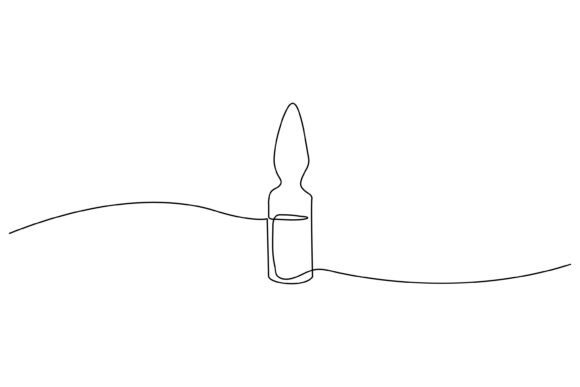
One Line Medical Ampoule
A Clean, Quiet Statement — Not Just Another Medical Icon
First glance at One Line Medical Ampoule isn’t about flash or detail—it’s about breath. A single, unbroken line traces the silhouette of a medical ampoule: slender, upright, slightly tapered, with subtle curvature where glass meets seal. There’s no shading, no interior detail, no label—just confident contour. As an embroidery designer who’s stitched everything from hyper-detailed anatomical hearts to playful stethoscope doodles, I appreciate how rare it is to find an illustration that feels both precise and poetic. This isn’t clinical. It’s calm. Professional without stiffness. Minimal without emptiness.
Where It Lives Best: Thoughtful Embroidery Projects
I recently tested One Line Medical Ampoule on a natural linen tote bag for a local nurse-owned boutique—intended as a quiet signature piece, not a logo splash. Stitched in soft heather grey thread on oat-colored fabric, it landed exactly right: legible at arm’s length, elegant up close, and unmistakably medical without leaning into cliché. That’s its sweet spot.
- Embroidered patches for scrubs or lab coats—especially when paired with a monogram or small initials
- Sweatshirt embroidery on the left chest or sleeve cuff (not center-back unless scaled generously)
- Baby embroidery on organic cotton onesies or burp cloths—gentle, symbolic, and gender-neutral
- Kitchen towels and aprons for healthcare-themed home goods or gifts for pharmacists, lab techs, or med students
- Nursery decor on pillow covers or framed hoop art—its simplicity reads well in soft, muted palettes
It also works beautifully in printable mockups for Etsy sellers listing digital embroidery files. Because it’s vector-based (EPS + SVG), scaling stays crisp whether you’re previewing a 2-inch cap front or a 4-inch tote placement.
Where to Pause—and Why
This design shines in restraint—but restraint demands awareness. Here’s where One Line Medical Ampoule asks for intention:
- Small hoop sizes (<3”): The ampoule’s height-to-width ratio means shrinking below ~1.5” risks losing visual clarity. At tiny scales, the line can blur into a dot or disappear entirely on textured fabrics.
- Stretchy or thin fabric (like jersey tees or lightweight rayon): Without proper stabilizer, the continuous line may pucker or distort. Use medium-weight cutaway + topping for best definition.
- Dark fabric: Since it’s a single-line outline, contrast matters more than with fill-heavy designs. Test thread color carefully—navy on black won’t read; charcoal grey on deep navy might.
- Curved surfaces (caps, curved pockets): The straight vertical flow translates well, but avoid placing it near seams or high-curve zones where distortion is likely.
- Frequent-wash items (baby clothes, tea towels): Its clean shape holds up well—but confirm your stitch density isn’t too sparse. Running stitch alone may fray over time; consider a light satin stitch edge if durability is critical.
What It Adds—Beyond the Thread
As a craft business owner, I judge designs not just by how they stitch—but by how they make the finished product feel. One Line Medical Ampoule elevates handmade presentation without shouting. It signals care, competence, and quiet pride—valuable currency for personalized gifts, boutique branding, or holiday embroidery for healthcare workers who rarely get meaningful recognition.
Customers respond to subtlety differently than bold graphics. On Etsy, listings featuring this design in minimalist compositions consistently earn higher engagement in the “nurse gift” and “med student graduation” niches—not because it’s trendy, but because it feels *chosen*, not generic. It supports brand consistency for small shops building identity around wellness, science, or compassionate care.
And for digital product sellers? Its status as an Illustration—not a clipart-style icon—makes it versatile across categories: a Graphics asset for embroidery files, printable wall art, or even subtle watermark elements in client-facing documents.
Practical Notes Before You Stitch
Before committing to a client project or bulk production:
- Test on scrap fabric first—especially if using textured, dark, or stretchy material.
- Review stitch density in your embroidery software. A true one-line design should run at low-to-moderate density—no unnecessary fills.
- Confirm hoop size compatibility. While scalable, very narrow hoops may require manual repositioning or digitizing tweaks.
- Inspect small details at 200% zoom—check for unintended breaks or anchor points in the vector file.
- Try black-and-white mockups to assess contrast before final thread selection.
- Use appropriate stabilizer: medium cutaway for knits, tear-away for stable wovens, and always a light topping for sheen control on dark fabric.
- Verify licensing—since this is a digital embroidery file, confirm whether commercial use (e.g., selling embroidered totes) is permitted under its terms.
Final Thought: Less Is Anchored, Not Empty
One Line Medical Ampoule won’t dominate a garment—but it doesn’t need to. In a market flooded with busy, literal, or overly decorative medical motifs, its quiet confidence stands out. It works because it trusts the viewer to recognize meaning without explanation. For embroidery designers, Etsy sellers, and makers building thoughtful handmade products, that kind of clarity is rare—and worth stitching carefully.